

As global climate action accelerates and regulatory frameworks tighten, understanding carbon markets has become essential for businesses operating in today’s economy. Whether you’re navigating mandatory compliance requirements or exploring voluntary carbon offset opportunities, carbon markets serve as a critical mechanism for achieving climate goals while sustaining economic growth. In this article, Ecoryx experts explain the fundamentals of carbon market compliance, from core concepts to practical strategies. For insights into specific global markets and MENA region carbon market developments, see our companion article: Carbon Markets in the MENA Region: Opportunities and Regional Leadership.
What is a Carbon Market?
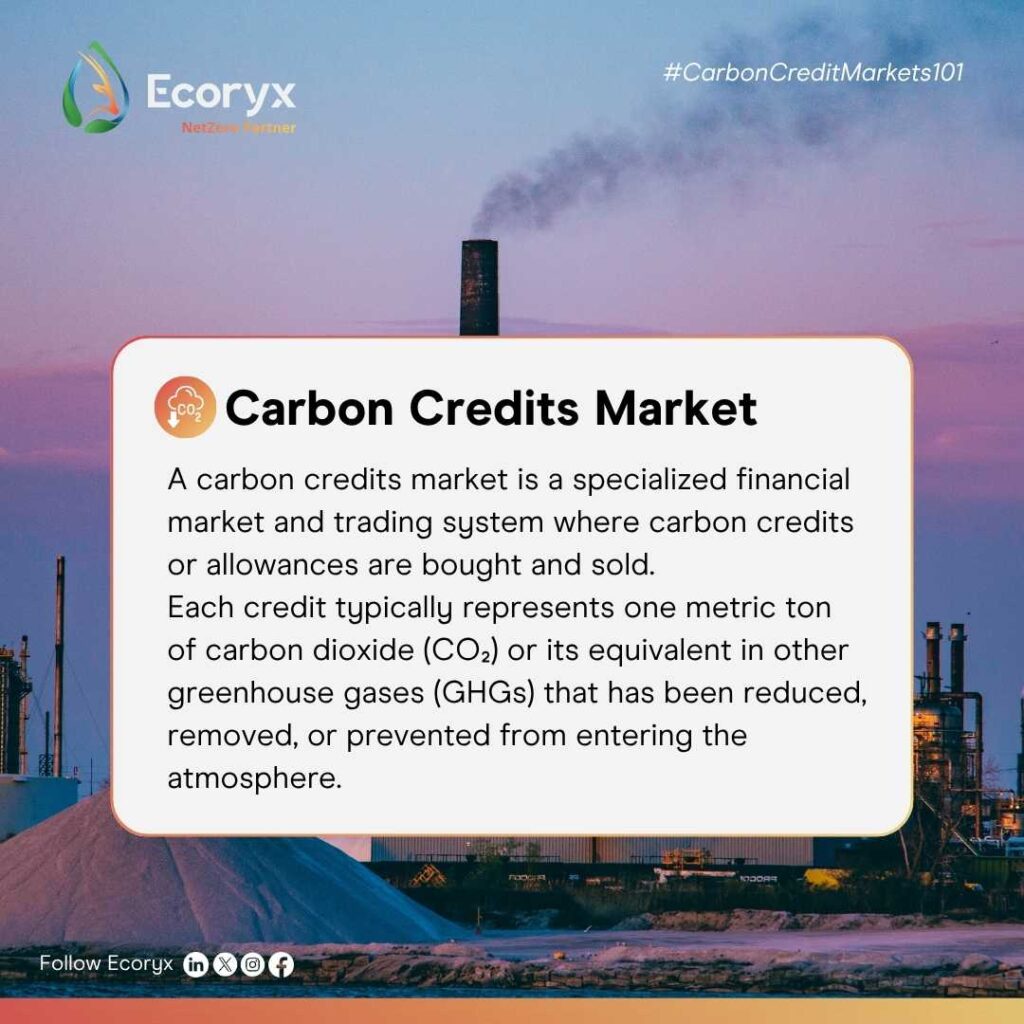
A carbon market is a specialized financial market and trading system where carbon credits or allowances are bought and sold.
Each credit typically represents one metric ton of carbon dioxide (CO₂), or its equivalent in other greenhouse gases (GHGs) that has been reduced, removed or avoided.
How Does it Work?
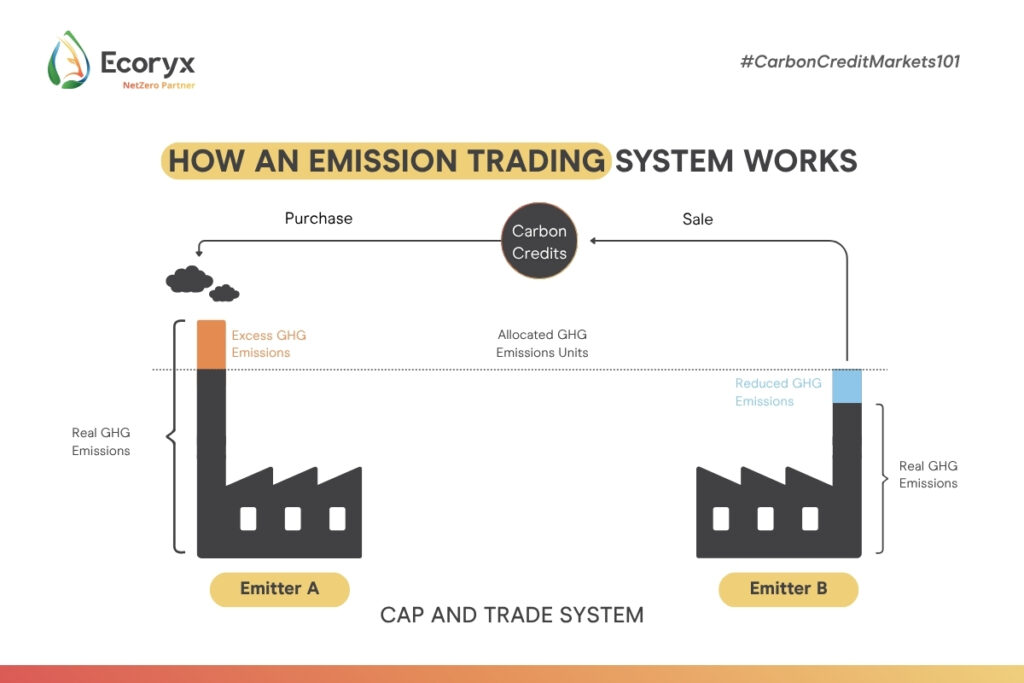
Carbon markets operate by putting a price on carbon emissions, creating financial incentives for businesses to reduce their greenhouse gas footprint.
Companies that reduce emissions below their allocated limits can sell surplus allowances, while those that exceed their limits must purchase additional credits.
Real-World Example:
A German steel manufacturer under the EU ETS reduces emissions by 10,000 tons below its allocated cap through efficiency improvements. It can sell these excess allowances to another company that has exceeded its limit, thereby generating financial value from its emissions reductions.
The Birth of Carbon Markets
The concept of carbon trading emerged from the 1997 Kyoto Protocol, the first international agreement to establish legally binding emissions reduction targets for developed countries.
The protocol introduced three market-based mechanisms:
- International Emissions Trading (IET): Allowing countries to trade emission allowances
- Clean Development Mechanism (CDM): Enabling developed countries to invest in emission reduction projects in developing nations
- Joint Implementation (JI): Facilitating emission reduction projects between developed countries
While the Kyoto Protocol laid the groundwork, the first operational carbon trading system, the European Union Emissions Trading System (EU ETS), launched in 2005. It has since become the world’s largest, most established, and multi-country carbon market.
Types of Carbon Markets: Compliance vs. Voluntary
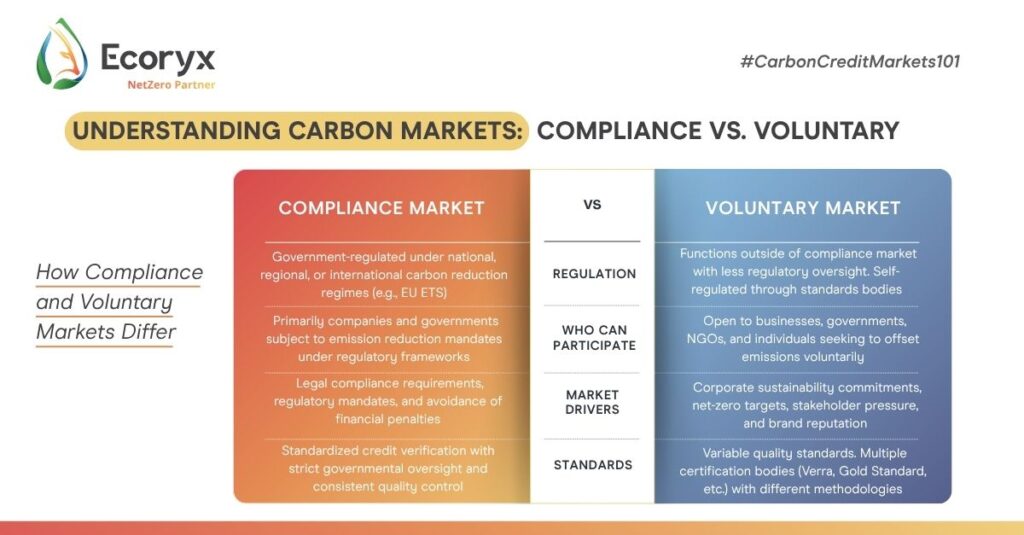
Carbon markets operate under two distinct frameworks, each serving different purposes and governed by different regulatory structures.
1. Compliance Carbon Markets (Mandatory Markets)
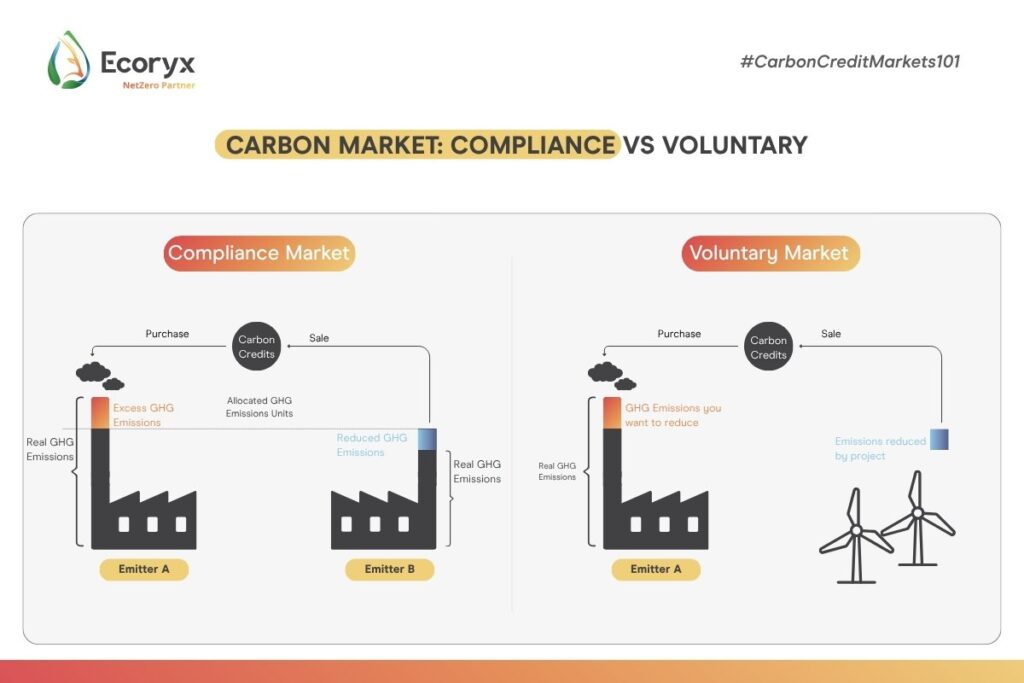
Compliance carbon markets, also known as mandatory or regulated markets, are established and governed by mandatory national, regional, or international carbon reduction regimes.
Companies operating under these systems are legally required to meet defined emission reduction targets.
When Compliance Markets Started
- 2005: EU ETS launched as the world’s first major compliance market
- 2013: California Cap-and-Trade Program began operations
- 2017: China’s national ETS pilot programs started
- 2021: China’s national ETS officially launched, becoming the world’s largest carbon market by coverage
How Compliance Markets Work
Compliance markets typically operate through two main mechanisms:
Cap-and-Trade Systems:
In a cap-and-trade system, the government establishes an overall emissions cap for specific sectors and distributes allowances to covered entities through free allocation or auction, with each allowance permitting the emission of one ton of CO₂e.
Companies must surrender allowances equal to their actual emissions annually. As the cap decreases over time to drive emissions reductions, companies can trade allowances in the market to meet their compliance obligations efficiently.
Carbon Tax Systems:
Another compliance carbon market mechanism is the carbon tax system, where the government sets a fixed price per ton of emissions, and companies pay tax based on their total emissions.
The revenue generated typically funds climate initiatives or is returned through tax rebates. Countries like Sweden and Finland have successfully implemented carbon tax systems.
2. Voluntary Carbon Markets (VCM)
While compliance carbon markets operate under regulatory bodies, voluntary carbon markets operate differently, where participation is entirely optional.
Companies, organizations, and individuals choose to purchase carbon credits to offset their emissions beyond any legal requirements, driven by:
- Corporate sustainability goals
- Stakeholder expectations
- Social corporate responsibility
- Brand reputation
How Voluntary Markets Work
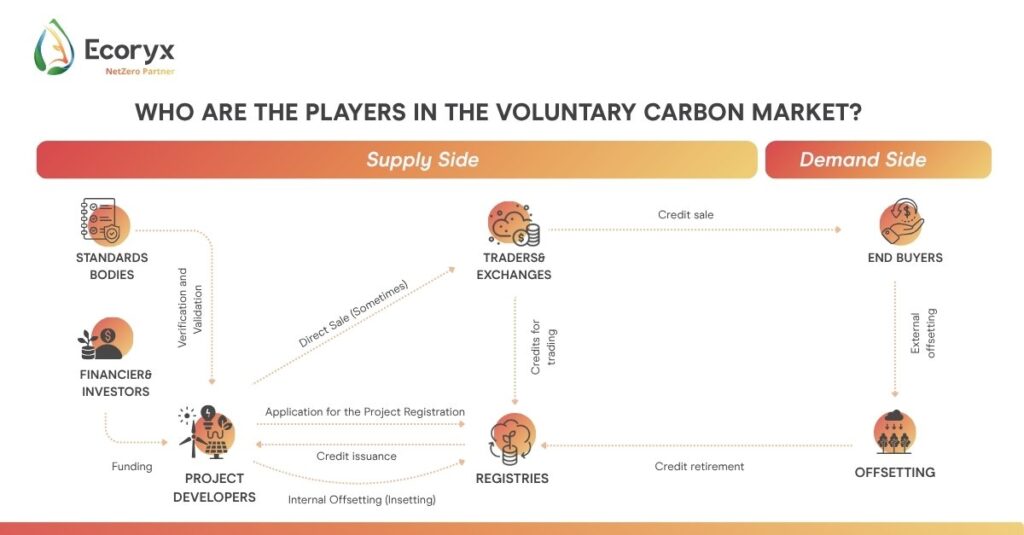
The voluntary carbon market functions through a straightforward process:
Project Developers: Project developers create emission reduction initiatives such as renewable energy installations, reforestation programs, or methane capture systems. They apply to registries for project registration and may sell credits directly to buyers or through exchanges.
Standards Bodies & Verification: Standards bodies such as Verra and Gold Standard set the methodologies and criteria that projects must meet. Independent verification bodies assess and certify the actual emission reductions achieved, ensuring credits meet recognized international standards before issuance.
Financiers & Investors: Development finance institutions, climate funds, and private investors provide upfront capital for carbon projects, often in exchange for forward agreements to purchase future credits, known as offtake agreements.
Registries: Centralized databases that issue, track, and retire carbon credits, ensuring transparency and preventing double-counting. Leading global registries include Verra’s VCS Registry and Gold Standard Registry.
Traders & Exchanges: Trading platforms and intermediaries where carbon credits are bought and sold.
End Buyers: Corporations and organizations that purchase carbon credits to meet voluntary or compliance climate commitments.
External Offsetting: When a company purchases credits to compensate for its emissions, those credits are permanently retired in a registry, ensuring the environmental benefit cannot be claimed twice.
Internal Offsetting (Insetting): Rather than purchasing credits externally, some companies fund emission reduction projects within their own value chain, retiring the resulting credits internally without transacting on the open market.
KEY TAKEAWAY
Compliance markets are mandatory and regulated by governments with legally binding targets, while voluntary markets allow companies to offset emissions beyond legal requirements to meet sustainability goals and stakeholder expectations.
Global Carbon Market Overview
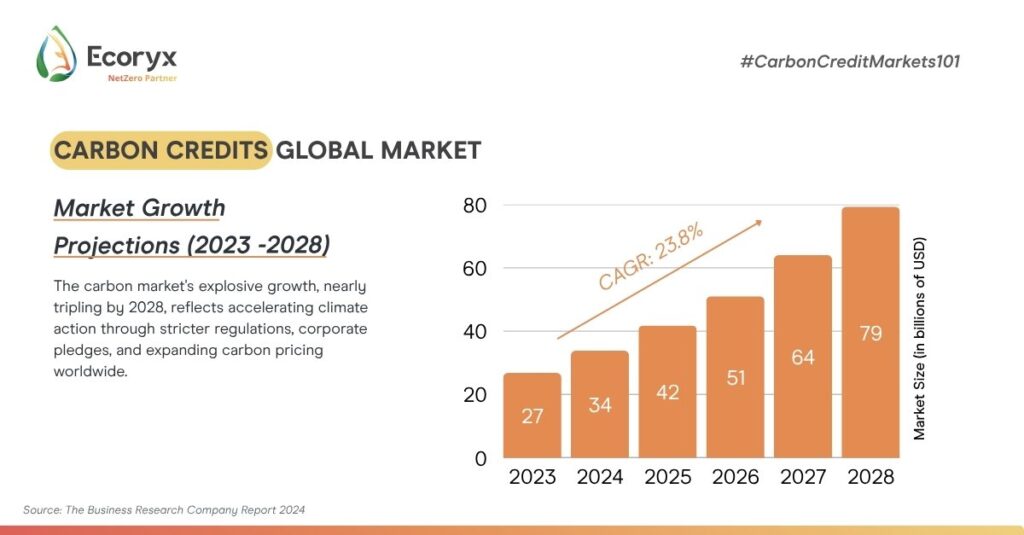
Valued at $27 billion in 2023, the market is projected to reach $79 billion by 2028, representing a robust compound annual growth rate (CAGR) of 23.8%. This expansion is driven by:
- Increasing regulatory mandates
- Corporate net-zero commitments
- Proliferation of carbon pricing mechanisms worldwide
Today, the compliance carbon market dominates global carbon trading, with the EU ETS alone accounting for approximately 87% of market value, while voluntary markets are rapidly scaling to meet corporate climate ambitions.
Major Carbon Markets Shaping Global Policy
Understanding the world’s leading carbon markets helps businesses anticipate how compliance requirements may evolve.
European Union Emissions Trading System
The EU ETS remains the world’s oldest and most valuable carbon market, covering around 40% of EU emissions across power, aviation, and heavy industry. The system operates on a cap-and-trade basis, with allowances distributed through auctions.
Its influence is expanding further with the Carbon Border Adjustment Mechanism (CBAM) entering full implementation in 2026.
China’s Emissions Trading System
Launched nationally in 2021, China’s ETS is now the world’s largest by emissions coverage, exceeding 4.5 billion tons annually. Initially focused on the power sector, the system expanded in 2025 to include major industrial sectors such as steel, cement, aluminum, and chemicals.
United States Regional Markets
Rather than a federal carbon market, the U.S. operates regional systems:
- Regional Greenhouse Gas Initiative (RGGI) covering Northeast power generation
- California Cap-and-Trade Program, linked with Quebec
- Washington State Cap-and-Invest Program, launched in 2023
Together, these programs have reduced millions of tons of emissions while generating significant clean-energy investment.
United Kingdom ETS
Launched in 2021 after Brexit, the UK ETS mirrors much of the EU system but follows a more aggressive emissions-reduction trajectory aligned with the UK’s net-zero target.
South Korea ETS
Operating since 2015, South Korea runs the world’s third-largest compliance market, covering roughly 70% of national emissions across major industrial sectors.
New Zealand ETS
Active since 2008, New Zealand’s system is notable for integrating forestry into compliance markets, allowing landowners to earn credits from afforestation and permanent forests.
How about Carbon Credit Markets in the MENA Region?
While still less mature compared to global markets, the MENA region is steadily developing the infrastructure needed to support carbon markets as part of its transition to a low-carbon economy. These efforts align with regional climate commitments and long-term net-zero targets.
In recent years, Saudi Arabia and the UAE have emerged as key drivers of this development. A major milestone came during MENA Climate Week 2023 in Riyadh, where the Greenhouse Gas Crediting and Offsetting Mechanism (GCOM) was announced. GCOM is designed as a domestic, voluntary, project-based carbon crediting mechanism and registry, enabling both public and private sector entities, including subsidiaries of foreign companies, to develop and trade carbon credits across sectors. The initiative supports Saudi Arabia’s pathway toward net-zero emissions by 2060 and contributes to the goals of the Saudi Green Initiative.
Alongside registry development, the region is also building carbon credit trading platforms. The Voluntary Carbon Market Company in Saudi Arabia operates a platform for auctioning and trading carbon credits across the region. Meanwhile, global exchanges such as AirCarbon Exchange have expanded into the UAE through regional partnerships to facilitate digital carbon credit trading.
Together, these emerging registries and exchanges are forming the foundational infrastructure needed to connect carbon project developers with corporate buyers and investors across the MENA region.
Navigating Carbon Market Compliance
Understanding carbon markets, whether compliance or voluntary, is no longer optional for forward-thinking businesses.
As regulatory frameworks tighten globally and stakeholder expectations rise, carbon market literacy becomes a competitive advantage.
Essential Actions for Businesses:
- Establish baseline emissions and understand your carbon footprint
- Stay informed about evolving regional regulations
- Explore carbon credit opportunities from efficiency improvements and clean energy adoption
- Prepare for CBAM and other trade-related carbon measures
- Engage with emerging regional carbon market frameworks
- Build internal capacity in carbon accounting and management
As carbon market infrastructure develops globally, early movers will be best positioned to capitalize on opportunities while meeting compliance obligations efficiently.
How Ecoryx Can Help
At Ecoryx, we specialize in helping organizations navigate the complex landscape of carbon markets and compliance.
Our Services Include:
- Carbon footprint assessment and baseline establishment
- Carbon management strategy development
- CBAM compliance and readiness assessments
- Carbon credit project development and verification support
- ESG reporting aligned with international standards
- Sustainability strategy aligned with regional vision initiatives
The carbon market landscape is complex, but you don’t have to navigate it alone. Ecoryx brings deep expertise in carbon compliance, ESG reporting, and sustainability strategy tailored to the MENA region.
Contact us today to learn how we can support your carbon market journey.
Leave a Reply