
The construction sector has long been framed as part of the climate problem, and the numbers back that up. According to the World Green Building Council, the built environment is responsible for 42% of annual global greenhouse gas emissions, with operations of buildings accounting for 27% and embodied carbon from materials and construction making up the remaining 15%. If no meaningful action is taken, the sector’s carbon footprint is projected to double globally by 2050.
But there is another side to this story. Few sectors carry as much potential for transformative environmental impact. And in Saudi Arabia and the broader MENA region, that potential is beginning to translate into real market momentum.
A Small Share, but a Fast-Moving One
Today, the MENA region accounts for just 4% of the global green building market. On the surface, that figure tells a story of slow adoption. Look closer, and it tells a different one, a market in the early stages of rapid acceleration, with the fundamentals to grow significantly over the coming decade.
Across the region, new construction projects are actively pursuing both local and internationally recognized sustainability certifications. This shift isn’t happening because of a single regulation or policy mandate, but is driven by a convergence of investor expectations, financing conditions, regulatory direction, and genuine market demand from tenants and end users who are beginning to ask better questions about the buildings they occupy.
The Gulf Region Is Leading the Way
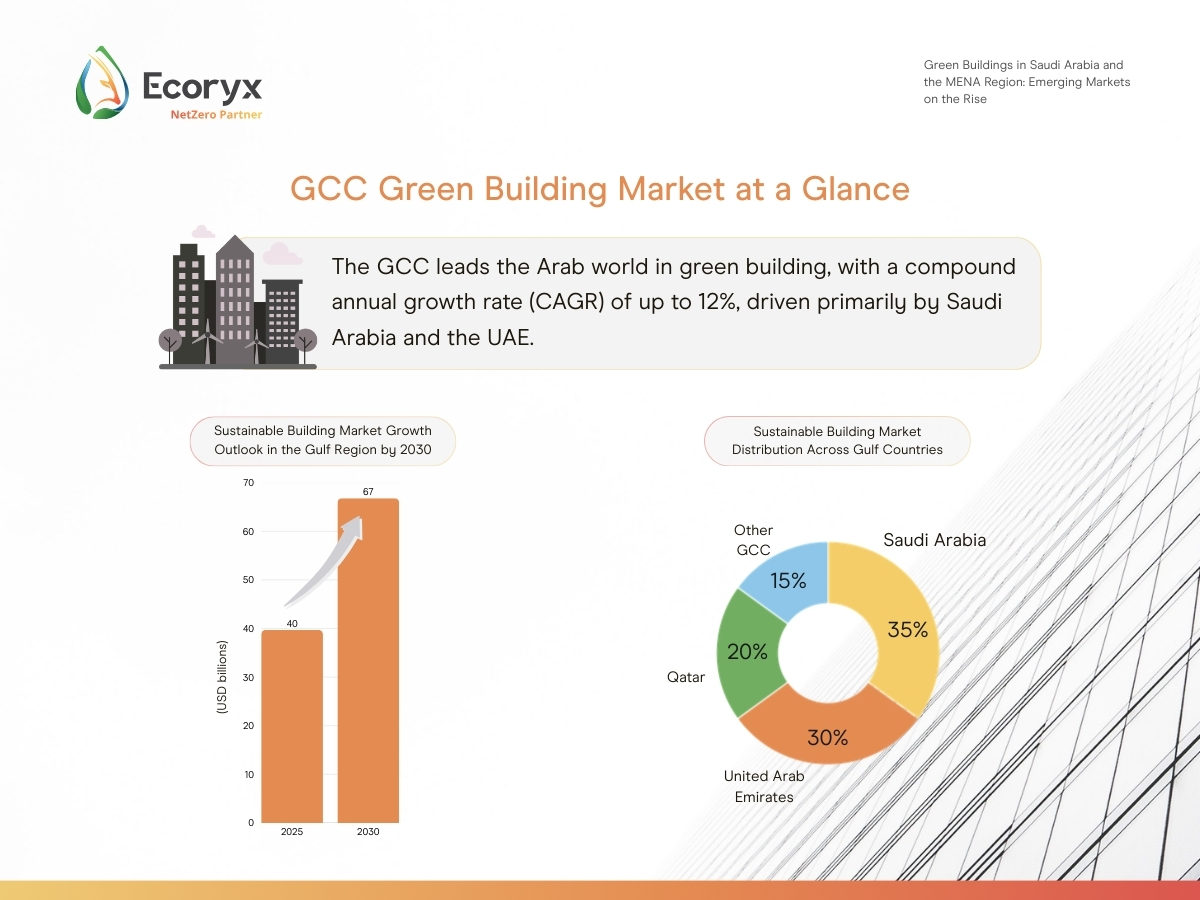
Within the broader MENA region, the GCC is the clear frontrunner. The region is projected to grow its sustainable building market at a compound annual growth rate of up to 12%, with Saudi Arabia and the UAE at the forefront. The GCC market is expected to expand from USD 40 billion in 2025 to USD 67 billion by 2030.
Saudi Arabia holds the largest share at 35% of the GCC sustainable building market, followed by the UAE at 30%, Qatar at 20%, and other Gulf states making up the remaining 15%.
Saudi Arabia’s Green Building Market by the Numbers
Saudi Arabia’s green building market has seen notable momentum in recent years, and the data from Q1 2025 underscores just how quickly things are moving. Projects registering for sustainable building programs grew by 64% in that quarter alone, reflecting a genuine acceleration in green building adoption.
The broader market trajectory is equally compelling. Annual growth is projected at 11%, with the Saudi green building market expected to reach USD 35.31 billion by 2032. Of the approximately 5,000 certified sustainable construction projects across the Arab region, 2,000 are located in Saudi Arabia.
Why the Business Case Is Stronger Than Ever
For real estate developers and construction companies, sustainability is now a competitive advantage.
Green-certified projects unlock sustainability-linked financing from regional banks, improving project bankability in ways that were simply not available a few years ago. Beyond financing, certified properties consistently command pricing premiums and faster sales velocity compared to conventional buildings. Globally, tenants accept on average a 10% rent premium for buildings offering high air quality, biophilic design features, and net-zero readiness. As demand for low-carbon office space continues to outpace supply, with the world projected to face a 70% shortfall by 2030, the competitive advantage of early movers will only sharpen.
Operationally, energy-efficient systems directly reduce running costs, while water-efficient infrastructure cuts utility expenses across the building’s lifetime. These aren’t marginal savings; they compound over decades into significant improvements in asset valuation and profitability.
Then there is the regulatory dimension. Mandatory ESG reporting is arriving across MENA. For companies that delay action, the cost will be expensive retrofits, compliance gaps, and potential exclusion from major government-led projects tied to Vision 2030 and equivalent national frameworks across the region.
The Challenges Are Real and Manageable
None of this means the path is without friction. High upfront capital requirements remain the most commonly cited barrier to sustainable construction adoption. For many development teams, the long payback periods of sustainable technologies are difficult to reconcile with short-term financial pressures.
Technical capacity gaps also persist. Many construction and real estate teams are building their sustainability knowledge from the ground up, and bridging the expertise gaps between engineering, finance, procurement, and operations takes time and investment.
What This Means for Organizations Operating in the Region
The sustainable building market in Saudi Arabia and MENA is not a future opportunity. It is a present-tense reality that is reshaping procurement decisions, financing conversations, and competitive positioning right now.
Organizations that build the capability to navigate certification requirements, manage sustainability data, and embed sustainable building practices into their project delivery will find themselves ahead of a curve that only gets steeper. Those who treat sustainability as a compliance checkbox, something to address only when required, will find the cost of catching up increasingly prohibitive.
The 4% global share that MENA holds today is just a starting point.
Ecoryx supports organizations across the region in their journey toward sustainable construction, from compliance assessment and certification support to construction sustainability management and capacity building.
Leave a Reply